
Will unexpected thunderstorm blackouts damage an off grid hybrid solar inverter?
A summer storm builds through the afternoon: wind first, then rain, then a flash nearby, and the lights go out as the local grid trips. In a house with an off grid hybrid solar inverter, the loads on its backup output keep running or return within a moment, and the owner’s question comes later: did the storm do any damage?
The blackout itself is rarely the danger. The surges that come with lightning are, and for a single phase solar inverter in a home they arrive through every conductor that leaves the building.
The Blackout and the Storm Are Different Events
A grid outage is, from the inverter’s point of view, simply the loss of one input. A hybrid unit detects that the AC input has moved outside its accepted range and supplies its backup loads from the battery and PV array instead, and nothing in that sequence stresses the electronics beyond normal operation.
An off grid hybrid solar inverter is built to handle this switching many times over its life. Batteries and PV then keep the backup circuits running for as long as stored and incoming energy allow, which makes a long outage a question of capacity, not of damage.
Lightning stresses the inverter in another way entirely. A direct strike to a building is rare but destructive, while strikes within a few hundred metres are common and induce voltage surges in power lines, PV cables and even data cables.
Further transients can arrive when the grid returns, because switching on long rural lines produces surges of its own. A compact solar inverter mounted indoors is protected from rain but not from surges arriving through its connections.
How a Hybrid Inverter Handles Grid Loss
When the grid fails, transfer time decides whether connected equipment notices. FRECON specifies the SP100 series with a transfer time of 10 ms in APP and UPS modes and 20 ms in GEN mode, and with AC input acceptance of 90–280 V in APP/GEN modes and 170–264 V in UPS mode, adapting automatically to 50 or 60 Hz.
UPS mode, with its narrower window, treats a sagging grid as a failure sooner, which shields sensitive loads during the unstable minutes that often precede a storm-related outage. Rated capacities of 2000, 3600, 6500 and 12000 VA, with surge ratings of 4000, 7200, 12000 and 24000 VA, set how much backup load each model can carry through the outage.
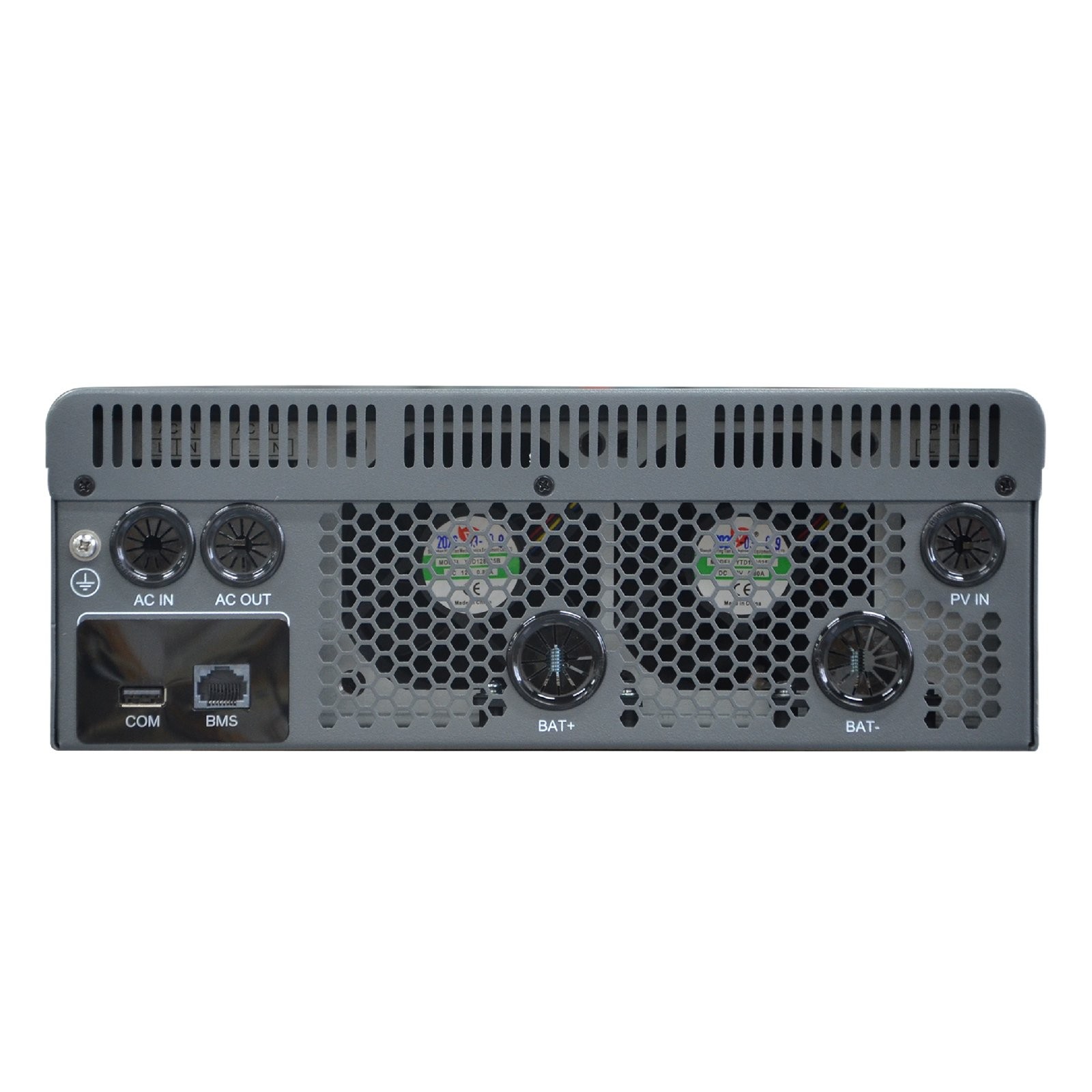
Not every output behaves the same way. The SP100-2000-12 and SP100-3600-24 have one AC output, while the SP100-6500-48 and SP100-12000-48 have two, and only the latter two support EPS load output for backup circuits.
Deciding which circuits sit on the backup output of a single phase solar inverter determines what keeps running when the storm takes out the grid. Battery choice is open between lithium and lead-acid types, and maximum battery-mode efficiencies of 91% to 94% across the four models govern how far stored energy stretches.
Where Surges Enter and How to Stop Them
Surges reach an inverter through the grid input, the PV cables running across the roof, and any long signal or communication line. Each entry point needs its own surge protective device, connected with short conductors to a common earthing point so that surge current is diverted before it reaches the electronics of a compact solar inverter.
Grid-side arresters at the main switchboard form only the first stage of that protection. Monitoring and network cables deserve similar care, since a surge on a long data line can destroy a communication port even when the power circuits survive.
FRECON‘s inverter FAQ describes the layered approach clearly. Direct strikes cause the most damage, induced surges from nearby strikes can overvoltage equipment, and residual voltage behind grid-side arresters can still harm an inverter, so a line arrester in the cabinet, built as a rail-mounted lightning-protection module with parallel grounding, is recommended. Storm surges that would otherwise reach the input stage of an off grid hybrid solar inverter are diverted once every entry point is protected.
Installation Details and the Answer
Placement adds a further layer of protection. The SP100 has an IP21 enclosure, so it belongs indoors and away from water, and its operating range of −10 to 60°C with relative humidity of 5–95% without condensation suits most utility rooms but not an open carport exposed to driving rain.
Above 2000 m, derating applies up to the maximum operating altitude of 4000 m. If the PV input has been isolated, solar charging can resume once the system is safe to operate, the PV input is restored through the DC isolator in accordance with the manufacturer’s instructions, and usable solar power is available.
Blackouts alone will not damage a correctly installed system, because the hybrid inverter is designed to switch sources. Surges are the real risk, and they are controlled by protection devices at each entry point, a common earthing system and an indoor location.
Protected in this way, a compact solar inverter from FRECON’s SP100 range, or any single phase solar inverter built to similar specifications, treats a thunderstorm blackout as one more transfer to battery power.